Monday, May 11, 2009

Universal Sacred Space


Universal Sacred Space Design

Our studies of the art and architecture of sacred spaces included many ways that human beings have found to express their relationship with the spiritual. Our design for a universal sacred space incorporated several of these, but is by no means all inclusive.
The Sacred Space is designed in which all who wish to worship could do so. It is designed to eliminate or minimize boundaries between the physical world of matter and the spiritual world to encourage the worshiper in their quest to differentiate between flesh and spirit and in their worship to approach their god or deity in spirit. We have chosen to make the area for congregation a small worship space as shown in the photo in order to emphasize the worshipper's connection with the surroundings and make transparent any perceived boundaries between matter and mind. Our Sacred Space has no roof and the rustic "natural" wooden seating emphasizes a connection to the physical world, while making a separation by standing or kneeling an easy accomplishment. This design incorporates aspects of nature while maintaining the desired transparency. Also, without a roof there truly is a lack of boundary between flesh and spirit, which as is the case with many religions assumed to exist either actually or metaphorically "above" the worship space. The rustic wooden seating delineates the congregational area for worship and a sense of longitudinal space is present in paths on either each side of the seating and between to accommodate processional ritualized worship. Our design utilizes the open spaces of the valley and beach to provide for communal space, open and without boundaries, where the worshipers are offered opportunities to admire the nature and beauty of Hawaii and hopefully be inspired .
The immediacy of the ocean, the basis of life on our planet, evokes thoughts of nature and ideas utilized by nature based religions as well as reminding some worshippers of more conventional faiths that utilize the metaphoric life nourishing aspect of water in their imagery of our connection to the sea.
Ideally the congregational would be entered from the South and the stage or podium would be on the North. A west exit to the ocean would be the location of the communal open air space flooded by natural light during the day and canopied by stars at night. The area between the Chapel and the ocean would provide a communal space. This space would permit a gathering overlooking the ocean and offered a feeling of protection and enclosure by the imposing walls of the beautiful Pololu Valley.
A short walk down the beach a prayer wall would be erected that would actually meander into the ocean. Worshippers could follow the path along the wall and pause to worship, or if appropriate utilize Conch shells to ritually scoop sand and return it to the beach, or water and do the same to symbolize a loved one lost, a celebration or a special prayer. The sand symbolizes how significant each grain is to the earth as people are significant to each other. There is the celebration of being washed in ocean water to signify the renewal of a person’s spirit. The ocean is pure and each wave represents the continual change that occurs day to day and moment to moment.
We would include pathways branching away from the wall that would lead to a scheduled area for various religious groups to worship in an area devoted to their specific practices and symbols. In each of these areas a small space would provide icons and symbols of a religious nature that would aid in the worship process. Christian crosses and statuary might be found in one location, carved Tiki's representing early Hawaiian deities in another, elements of worship of Judaism and Islam might adorn others. The Pololu Valley would provide an ideal center for a unified sacred space, that would include a ritual journey that would lead to this sacred site. In addition to a "normal" path from a parking area located on the peaks above the Pololu Valley, the chapel would also have a path that would be a secondary path for those seeking enlightenment that is long and somewhat difficult for the worshipper to trek to reach the sacred site. The path would resemble a smooth flowing shape that will be a unified symbol for peace and harmony. It should do this because its purpose is to challenge the mind but at the same time keep the mind in a tranquil state of being. The path would go through a cave, over water, through the forest and then last up the mountain so that the person would be able to see the path that creates a symbol of peace. Then after being on top of the mountain there will be a straight path leading to the entrance of the sacred space. If will feel welcoming to the person and also give a feeling of accomplishment and reunite one with the supreme power.

Our universal sacred space is a sanctuary located on the coastline at the base of a lush valley. As you sit among the congregation the open air design of the sanctuary allows you to hear the waves hitting the coastline in the background. Your sense of smell is stimulated by the fresh scent of the ocean air. As you exit to the west you face the ocean in the background which is only a few feet away. The view gives you the feeling of freedom and limitless opportunities. In the evening you see a beautiful ocean sunset as you exit the sanctuary. Palm trees and tropical foliage surround the sanctuary on the north, east, and south sides. Tropical breezes flow freely through the sanctuary along with the sounds of the rustling palm trees. The sanctuary is always very relaxing especially when it is raining. The sound and smell of the rain is very mesmerizing.
In order to keep our sacred space completely natural, the entire structure is built with materials provided by nature. One of our main goals was to provide worshipers the opportunity to become one with nature and be away from the trappings of modernization. Our sanctuary is accessible by a winding wood planked path that separates the parking area from the sanctuary. This insures that you cannot hear or smell the congregation’s automobiles when visiting the sanctuary. Torches and lanterns are used to light the sanctuary and walking path. The flickering light is relaxing and provides symbolism and the warmth of fire. Our sacred space gives worshipers of all religions the opportunity to become one with nature and their god.
The Universal Sacred Space is located between two mountains in the Pololu Valley. The sacred space and solitude of the structure is to allow people to recapture inner peace. The structure is made from wood from the valley. The building itself is made of all natural substances. The planks are constructed, not using nails but of natural fittings. The benches are also made from wood from the valley. Amazingly the entire structure is built to withstand the winds and rainy seasons. The structure is open so as people enter through the structure on the south side they are greeted by the luminous light that fills the structure from the east to the west. The north end of the building is open and the view past the podium is that of the wall of mountains of majestic colors that surround Pololu Valley. The salty winds blow in from the west and people are embraced by the sounds of the ocean. The structure is designed so that entry will only occur from the south with the emphasis on the procession to the open alter. The exit is to the west where the people are to proceed to the ocean so to symbolize a new beginning.
Earth and water are life-sources or sustainers of life. In Assyro-Babylonian mythology, first the gods and subsequently all beings arose from the fusion of salt water (Tiamat) and sweet water (Apsu). The holy books of the Hindus explain that all the inhabitants of the earth emerged from the primordial sea. At the beginning of the Judeo-Christian story of creation, the spirit of God is described as stirring above the waters, and a few lines later, God creates a firmament in the midst of the waters to divide the waters (Genesis 1:1-6). In the Koran are the words We have created every living thing from water. Judeo-Christians also have many representations of "sacred" springs, etc because of a connection with a miraculous event. Water also represents springs and well such as the fountain of youth, etc.
The Celts also had a unique way of looking at water and wells. Water was the boundary between the otherworld and our world. It was the boundary between land and sky. Since the water came from the otherworld and/or deep from the earth it was especially blessed. Water that bubbled to the surface or that was steamy and hot was especially thought to have healing properties to pre-Celtic and Celtic as well as Roman settlers to these countries. Also, when you think about the Celts and where they lived, surrounded by water on all sides, you begin to realize that they more than likely realized the strength of water and how it could both destroy and heal.

Monday, April 20, 2009


Johnny Limones


Pyramid of the Sun


General Description


One of the largest buildings located in the city of Teotihuacan is the ancient Pyramid of the Sun. The Pyramid of the Sun is an old pyramid that was built by the Teotihuacanos in two phases and then was later abandoned and inhabited by the Aztecs. There is still not much known about the Teotihuacanos. Discoveries show that most of the construction was done from 100 A.D. till many years after even though it seems as if the city was established during the time of Christ and would be used as a place of worship. It is the third largest pyramid and was one of the largest cities in the fourth century with a population of about 125,000 inhabitants. Three centuries later, their civilization had completely diminished. There is still a controversy over what actually happened to them.


Architectural Design


The pyramid is made of stone and originally plastered and painted red. Along with the red paint there were many big and beautiful murals painted on the inner walls. The size of the pyramid is 738 square feet at the base, and has a height of 233 feet. The design had four distinct platforms. It had a temple, and an Adosada platform. Unfortunately, the temple and the upper levels of the pyramid no longer exist and are destroyed. In the early 20th century the pyramid was reconstructed with five platforms. Many admirers of ancient locations were not to pleased with the changes so there was a bit of speculation.


Harmony with Nature


There is a row of stairs that face west towards the direction of the setting sun. The sun was the center of attention and power therefore the Aztecs believed that the pyramids main purpose was to worship the sun. It is also noted that the pyramid seems to be in the same orientation as the Mayan long count calendar and therefore has a higher significance in its use and could have been a symbol for time. However, this might not be the true purpose that the Teotihuacanos had for the pyramid. The fact that there is a natural cave is an example of its connection to nature as well thus showing another reason of why the pyramid was built at that specific location.


Symbolism and Sacred Objects


A couple of artifacts were found in the pyramid one of which is a vessel that had an image of the Storm God Tlaloc. This god’s purpose did not necessarily emphasize the function of pyramid but was stilled worshiped in the pyramid. The place where this pyramid is said to be is where men would go to become gods. There is a cave underneath the pyramid and is thought to have burial chambers with corpses in them that might lead to further explanation of the pyramids purpose. The adosada platform is decorated with many figures of animals like jaguars and snakes which seemed to have some kind of godlike importance.


How it was used by Worshippers


The use of this pyramid by worshippers is not certain but as stated before many believe it is o give praise to the sun god. The cave that is under the pyramid could have been used for burials of important spiritual people. There could have been ceremonies that took place that would turn men into gods. Whether the entire pyramid was intended as a burial place or as a place for the sun god is not known. The main use would be by the Atecz in their worship for their gods. The use of the pyramid changed of course and is now a historical landmark.


Sources


Mario Maiorana


The Ziggurat of Ur


General Description:


The Ziggurat of Ur is located in southern Iraq. It was built in what was then the city of Mesopotamia between 2250-2233 B.C. Ur-Nammu became the ruler of the cities of Mesopotamia around 2100 B.C. He built several Ziggurats to worship gods. They were built up until 500 B.C. The Ziggurat of Ur was built to worship the moon god Nanna.


Architectural Design:


The Ziggurat has a pyramid look to it. The front has three sets of steps leading to the top. The size of this structure is breathtaking considering when it was constructed. The structure is filled with sand. As you walk around the structure you see hundreds of openings which allow water to escape and allow for expansion caused by moisture. On the left, right, and back side of the structure there is a small set of steps that lead into a false entranceway giving the appearance that the structure is hollow and you can enter it. The faces of the walls have several staggered vertical layers giving a pillar like appearance. The facade of the Ziggurat has eroded throughout the years and is missing the top three levels. In 1923 an excavation jointly sponsored by the British Museum and the University of Pennsylvania Museum cleared the rubble around the Ziggurat. It was reconstructed to its present state by the Iraqi Directorate of Antiquities.


Harmony with Nature:


Being in southern Iraq, the surroundings of the Ziggurat are vast flat desert land. On the left side of the Ziggurat are the excavated remains of the city of Ur. The bricks that construct the Ziggurat are the same tan color as the desert sands that surround the structure. The Ziggurat can be seen from miles away due to its size. The view from the top of the structure is immense and desolate. It is relaxing to look at the Ziggurat from a distance in the quiet desert.


Symbolism and Sacred Objects:


Obviously the Ziggurat has great symbolism as a religious artifact. There are also tombs that have been excavated which are quite amazing to the left side of the structure. The tombs are underground and built of brick like the Ziggurat. Many of the bricks in the tombs have script carved into them. The home of Abraham has also been reconstructed on the site.
How it is used by Worshippers:
Ziggurats enabled worshipers to get closer to the gods they worshipped. This aided in their communication with the gods. Ziggurats were also built as an offering to the god the city worshipped.


Personal Experience at the Ziggurat:


In 2003 I had the great opportunity to visit the Ziggurat and the remains of the city of Ur. I was also able to see the Ziggurat from the base I was stationed at. It is a beautiful sight especially considering that it was created 4000 years ago.
Sources:
Ziggurat. The Metropolitan Museum of Art <http://www.metmuseum.org/toah/hd/zigg/hd_zigg.htm>
Ur. University of Pennsylvania Museum of Archaeology and Anthropology <http://www.mnsu.edu/emuseum/archaeology/sites/middle_east/ur.html>
Ancient Babylonia - The Ziggurats. Bible History Online <http://www.bible-history.com/babylonia/BabyloniaThe_Ziggurat.htm>


Vanessa Mayhew


Great Pyramid

General Description:

The Great Pyramid is located on the edge of the Giza Plateau. The Great Pyramid is the largest pyramid ever built. You can not truly understand the size and intensity of this massive pyramid unless standing before it. The numbers do not do justice to the description of how large the Great Pyramid truly is. Dr. John DeSalvo clarifies, “Today, with all our modern science and engineering, we would not be able to build a Great Pyramid of Giza.” This statement truly defines the work and genius put into the formation of this pyramid.

Architectural Design:

According to PBS.org the Great Pyramid was built with over 2,300,000 stones, it weighs 6.5 million tons, the original height was 481 feet and the angle of incline 51 degrees. It was built with limestone and granite which really defines why it weighs as much as it does. Each block is said to weigh at least 2.5 tons and the largest were possibly 9 tons. The pyramid was made of limestone in order to allow the sun’s light to reflect and make the pyramid shine. Another unique architectural fact is that “it is the only pyramid in Egypt that has both descending and ascending inner passages” (DeSalvo). This addition of ascending passages must have a distinctive purpose, along with the airshafts that were built in the King’s and Queen’s chambers.

Interior Features of the Great Pyramid

Harmony with Nature:

The accuracy of the direction the pyramid is facing is a true harmony with nature. It is the most precise north oriented structure because it is only 3 minutes of a degree off of true north. According to Dr. DeSalvo, the 3 minutes of a degree of true north is because of natural forces in the earth and when it was built originally, the Great Pyramid was true north.

Symbolism and Sacred Objects:

One sacred object within the Great Pyramid is the Coffer in the King’s chamber because it the same volume as the Ark of the Covenant in the Bible. Dr. DeSalvo would like to hypothesis that possibly there is a connection between the Ark in the Bible that would actually produce electricity and the Great Pyramid. Could this pyramid have electro-static producing effects?
This pyramid is also sacred to many because pyramids are said to be used for tombs for pharaohs but without any remains found in this pyramid or any decoration it is hard to say this was the purpose of this pyramid.

How it is used by Worshippers:

The Great Pyramid is the first wonder of the world as listed by the Greeks. This is amazing considering there are only seven world wonders left today. The true purpose of the Great Pyramid is unknown, along with the exact age but there is evidence that it was protected. This pyramid has been adopted by different individuals throughout it’s history and also explored by different men, each having their own reactions. One thing that seemed to be agreed upon is the mystery of the massive structure and differing views on how and why.

Sources:

Great Pyramid of Giza Research Association. Ed. John DeSalvo. 16 Apr. 2009 .

"NOVA Online/Pyramids/Khufu/Khufu's Inside Story." PBS. 16 Apr. 2009 .


Karyn McCoy


Stonehenge


General Description


The mystery of Stonehenge has brought many scientists and philosophers to its location to answer the question as to whom or what built Stonehenge. It remains a mystery although there are a lot of stories that give credit to Merlin the magician, aliens or the people that lived 5,000 years ago. Stonehenge is located in a field in England. The Stonehenge we see today stands in ruin. To better understand Stonehenge is to relate to the architecture in three phases.


Architectural Design


Stonehenge 1: 5, 000 years ago, a circle was dug 320’in diameter, 20’wide and 7’ feet deep. Two parallel stones were placed at the entrance of the circle; one of the stones still remains. Stonehenge was used for 500 years and then abandoned.
Stonehenge 2: Approximately 2100 BC, a semicircle of granite stones was added to Stonehenge. These stones were called bluestones. These stones were believed to only exist 250 miles away. It is a mystery as to how they were brought to the location adding an air of mystery to Stonehenge. These stones were placed at the entrance and are aligned with the sunrise.
Stonehenge 3: This part of the construction is what is left today that observers see in ruin. The Sarsen stones can be located 20 miles from the location. They were brought to the location and were up righted and each one was topped with a horizontal stone. Originally there were 30 stones, 17 still remain standing. In this ring 10 more stones were up righted, 8 of these stones remain standing. A century later 20 more bluestones were added. These stones were placed in a horseshoe. Unfortunately only half of these stones remain.
Harmony with Nature:
There is so much mystery about Stonehenge that there is air of magic about the place. The bluestones that were brought to Stonehenge are some of the most curious. If the stones get wet or cut there is a blue hue about them. This gives people a belief that the stones have magical powers. It is believed to be a place of ancient healing.


Symbolism and Sacred Objects:


There is evidence at Stonehenge to indicate that it may have been used as a burial site, as there were skeletal remains found. Stonehenge may have also been used as a crude surgical location with the belief that there were magical medical powers to help healing. Stonehenge simply may have been an astrological site or a religious site. Each stone was placed with care and considered sacred to the ancients.


How it used by Worshippers:


The ancients observed it as a place of honor. Although it predates any known religion it is believed to have been used as a place of worship for Celtic paganism. The people that built Stonehenge had a vision and it served its purpose then. It is a place where thousands gather every year to view the Stonehenge and to give honor to its mystery. Those that visit believe they leave with a renewed sense of spiritual energy.


Roy Mullins


Rothko Chapel


General Description


The Mission Statement for Rothko Chapel states the purpose of the Chapel in simple elegant terminology, “The Rothko Chapel is a sacred space, open to all, established to advance human rights, interfaith understanding and justice.”
The Rothko Chapel was dedicated in 1971 after a building process that took seven years from the time it was commissioned by the John and Dominique de Meril family. The chapel presents an unassuming exterior of beige brick walls, unpierced by windows and with unobtrusive and understated entrances. The building is simple. In this simplicity it eludes the exclusion of any and avoids any obvious connection to a particular idea of the sacred. Although not actually a part of the structure, the reflecting pool that contains Barnett Newman’s sculpture, “Broken Obelisk” contributes to the visitor’s adopting a mood of peace and reverence as one enters the building.


Architectural Design


The Rothko Chapel was originally commissioned by Dominique and John Meril as part of Phillip Johnson’s design for the University of St. Thomas campus in Houston, Texas. Later the Meril’s dissociated themselves and their project from the university. The interior of the chapel contains fourteen paintings commissioned from Mark Rothko and he worked closely with Johnson in the design of the structure. Rothko erected a mock up of the planned design for the chapel in his New York studio and he insisted that the chapel recreate every nuance of lighting and environment. Johnson eventually resigned from the project but returning later in a consulting role he designed the main entrance to the chapel and the reflecting pool for Barnett Newman’s sculpture, “Broken Obelisk.”


Harmony with Nature


The Rothko Chapel creates a contrast with its surroundings rather than a harmony. It is stark and angular but surrounded by trees and it has a reflecting pool with an equally angular obelisk. This contrast between the natural and the manufactured is effective in acknowledging the coming together of two essentially different aspects of Being, that of the human and of the divine or spiritual. Moving from the tree lined park-like environment toward the cubistic structure one’s appreciation for the distance from nature and spirit that is created by the artifacts of man is confirmation that a quieter, more reflective place for an approach to the ineffable is in order. Entering the chapel the spare surroundings focus the visitors’ attention onto the huge paintings that dominate the walls. These paintings were created by Mark Rothko with intent that “the viewer might experience a sense of intimacy, as well as awe, a transcendence of the individual, and a sense of the unknown.”


Symbolism and Sacred Objects


At the dedication of the Rothko Chapel in 1971, Dominique Meril remarked, “We are cluttered with images and only abstract art can bring us to the threshold of the divine.” It is in the spirit of that statement that Rothko’s fourteen paintings establish a mood of meditative reflection devoid of any representational imagery that would iconically invoke a particular object of worship, deity or God. The chapel is designed to evoke a meditative experience that will lead the visitor to experience that personal interaction with the Other that is most often associated with worship.


How it is used by Worshippers


Rothko Chapel is, according to their website, “A sacred space open to all, established to advance human rights, interfaith understanding, and justice.” On the calendar for the chapel in April are gatherings and services of various sorts including, modern Turkish Sufi music, A presentation on human rights under the Obama administration, an arts community open house, a presentation of Gnostic songs interpreting the Gnostic gospels, and a Hindu Kirtan. The chapel is intended to serve as a sanctuary for all religions and denominations and serves as a temporary place for celebrations and worship for organizations that have no spiritual home.
Sources

1. Rothko Chapel. History of the Chapel. http://www.rothkochapel.org/history.htm
2. Rothko Chapel. Programs. http://www.rothkochapel.org/events.htm
3. Images of the Rothko Chapel. http://www.bluffton.edu/~sullivanm/texas/houston/rothko/chapel.html
4. Rothko Chapel. View the Floor plan. http://www.rothkochapel.org/floorplan.htm
5. Mark Rothko. Wikipedia. http://en.wikipedia.org/wiki/Mark_Rothko
6. Houston Press. Blogs. Hair Balls. “Rothko Chapel: Yahoo! Says To See It Before You Die. (That Way You'll Be Depressed Enough, At Least),” http://blogs.houstonpress.com/hairballs/2009/03/rothko_chapel_before_die.php


Friday, March 27, 2009


Johnny Limones
Museum Exhibition at the Kimbell Art Museum
Art & Love in the Renaissance

Though I may be and Architecture Major I find art to be a very interesting addition to my area of study. Art is unique, and the original piece made may be the only one of its kind. Other types of art may look like the strangest thing you would ever see but it would be considered art by the one who made it. It is very interesting to see what visions a person has in the mind and to put it on canvas for many to enjoy what he or she sees. Knowing that I am also focused on architecture I notice that there are similarities in between the artist and the architect. I combined these two aspects for my visit to a museum exhibition and decided to go to the Kimbell Art Museum in Ft. Worth that was designed by the great architect Louis Khan. The exhibition that took place at this location was called Art & Love in the Renaissance.

As I enter the exhibition I see many different unique works of art but there was one piece that immediately caught my attention. I chose a painting created by Francois Boucher in 1769 that is called Juno Asking Aeolus to Release the Winds oil on canvas. It was acquired in 1972. It involves a scene of a book called The Aeneid written by the Roman author Virgil. The goddess Juno is shown and apparently is filled with jealousy towards another god Venus. Apparently Juno schemed to prevent the fleet of Venus’s son, Aenas, from the shore and from founding a Trojan colony in Italy. Aeolus the keeper of the winds is a nymph and Juno offers her his most beautiful nymph in return for his help. That is roughly the scene that was painted on the canvas by Francois. It interested me not by the story behind it but be the detail and activity in the painting. You can see one of the nymphs scheming to do no good by the look on his eyes towards another nymph. The detail in the nude bodies are really good and it just blew me away when I started to think of how long it would take to make and perfect a painting like this one. I took a step closer to look at the texture of the brush strokes and I noticed the enormous talent of the artist. I have tried to complete a painting of my own and I have come to find out that it takes a long time to make a work of art and appreciate it.

In conclusion the painting was so big that it gat its own wall to be placed on. As I was leaving I took a moment to not only admire the art on the walls but to admire the walls themselves. You may be wondering why I say this. I say this because to me and many other people the building is a work of art itself. The thought of the design and the construction of it also amazes me by also thinking of how long it took to make. Therefore I hope to one day have a design and creation of my own.


Mario Maiorana
Museum Visit
For my museum visit assignment I visited the Tutankhamun exhibit at the Dallas Museum of Art. The exhibit displayed many works of art that were created in Egypt and buried with King Tut and his family. It is amazing how detailed the artwork of this time is especially considering the limited tools they had to work with.
I chose a crystalline limestone carving that was part of an entrance ramp in Akhenaten’s palace in Amarna. The artwork depicts King Tut’s father Akhenaten, Queen Nefertiti, and their daughter Meritaten. They are standing in a row facing a solar disk which represents Aten who is the god of the religion Akhenaten formed as the religion of Egypt. Rays from the solar disk shine down on the three whose hands are extended toward the rays. Hieroglyphics are spread throughout the piece some of which are Ankh which stand for life, birds which stand for travel to the after life, flowers which are lotus buds, and oval shapes which stands for Pharaohs. This artwork reflects the new religion Akhenaten created for the people of Egypt.
The elements of line are represented vertically and horizontally depicting rays from the solar disk at the top right corner of the carving. The lines are straight, thin, and long. They focus the emphases on the solar disk and royal family. There are invisible implied lines from the faces of the royal family to their hands that are extended into the rays. There are many flat objects and shapes depicting forms of the royal family and symbols of religious importance. The figures of the royal family are proud and strong. They are staggered from short to tall in a row from the daughter who is the smallest on the left to the king who is the largest on the right. They are located in the middle ground of the carving since they are the subjects. Space is totally utilized in this piece with the subjects of the work, and hieroglyphics. The size of this piece is smaller than us. The artist does a great job making this flat carving seem to visually project into our space. The solar disk has an atmospheric perspective of being a distance away from the royal family. Light is implied from the natural source which is the solar disk. The royal family interacts with the implied light by facing it. The color of the carving is the natural tan color of limestone. The texture is smooth. The balance of this piece is weighted to the left. The emphasis first draws your eye to the royal family and then to the solar disk. The rhythm of this piece is created through hieroglyphic ornamentation. The media technique is two-dimensional that was created using the subtractive process.
This assignment helps me appreciate art at a higher level. In the past art would not register with me. Now I look at art with more analysis. I think about what the artist was trying to communicate.


Karyn McCoy


A DAY AT THE MUSEUM
I have found that the definition of Art may be interpreted in many forms. It may be a painting, a sculpture or literature. I attended the Texas Civil War Museum in Ft Worth, Texas. The collection of pieces was absolutely extraordinary. The tour started with an informational video on the Texans involvement in the Civil War. The exhibits were then open to view. They included many artifacts, pictures of the soldiers and uniforms that were actually worn by the soldiers including the bullet holes. I found the blood stained flags moving and the exhibit of the women’s clothing worn during the Victorian time incredibly beautiful. The paintings that were displayed were few and quite guarded.
I chose the portrait of Varina Anne “Winnie” Davis. The painting was displayed in a very special place in the museum. It was corded off in a corner of the museum as though the viewer had just entered a living room and Ms. Davis was waiting for a visit. She was born in the Confederate White House in 1864. She made numerous appearances with her father Jefferson Davis and became known as the “Daughter of the Confederacy”.
The painting defined the time. The lines that are in the picture are thick and vertical, it makes the picture appear larger than life and the subject appears as though she could stand up and walk out of the room. Her hand is resting on a diary and it draws your eyes to the writings. The artist placed her in the foreground to emphasis her importance, unlike the women of the time she is not dressed in fancy clothing but instead of casual dress. The placement off her hand on her hip shows that she was not demur but instead strong willed. The objects in the painting are few. She is sitting at a table with only a vase of flowers. The room is well lit, no curtains and the view draws the viewer to look outside the windows. Each window is framed. They could each be a separate but the emphasis is on her. The colors used in the painting are not intense. The viewer is walking into the past. As though the day was foggy and it was unclear as to what would happen to those on the losing end of the Civil War. Her jacket and belt are black and the dress shows the worn colors of yellow. It is as though the dress had been yellow at one time. The painting is an oil painting and it looks aged. It is smooth and rough in some areas giving the viewer the feeling that she is a real person.
The painting is balanced by the use of color and light. The artist uses black to place the non importance of the items in the painting. Light is used to place emphasis on her face and lighter colors are used for the background and dress. It is as though the viewer is drawn to her importance and then the eye wanders to the background to see what is going on outside. She is centered to show that she is the focal point. There is repetition in the picture as there are four different pictures in the foreground. Each one is defined by lines but each background is different. As the viewer looks from left to right in the background it is though it is a panoramic picture that is telling a story. The painting is dated 1913, fifteen years after the subject died. Her youth was captured in the oil painting. There are parts of the painting that are darker which may or may not indicate that it was touched up. Most of the strokes are rough, but there are some areas that are smooth. The black in the

Vanessa Mayhew

Museum Visit

I work at the Hurst Public library and we have art displays that change frequently and the month that we were assigned our museum visit assignment, David Mask’s artwork was displayed in our library. I was very intrigued by his work but the piece of art with a paper airplane was the most interesting to me. I wanted to analyze this painting to look further than just the painting and use the visual analysis to figure out exactly what made this piece interesting.
The focal point of this piece of art is the paper airplane. My eye is draw to the lightest and most bright color on this painting. The artist placed the paper airplane in the foreground because it is the primary emphasis of the artwork. Every line and color revolves around the paper airplane. The artist was able to create very straight and defined lines with the paint he chose. He was also able to define textures through overlapping colors. This artwork was more flat than shiny. Lines are very important in this piece of art. The lines used are straight, long and thin throughout the entire painting. They define the paper airplane and the direction it is moving. They strongly draw attention to the movement of the airplane. The plane has great emphasis on it because the outlining is bolder than any other dark/black lines in the painting. There is a diagonal direction emphasized by the diagonal horizon through the painting. The lines express a mechanical feeling that makes the straightness and equality of the artwork stand out. There are four main colors used in this piece of art (blue, very light brown, white and orange). The artist uses some complimentary colors. The artist uses cool (the sky or top and paper airplane) and warm (the ground and the implied path of the airplane). Triangles are the only defined shape in this piece of art. The two main triangles in the paper airplane are volumetric because they make the plane stand out and they have been given a three-dimensional quality and geometric. There is empty space without objects that I believe represent the ground and the sky. The paper airplane makes the observer feel/look smaller because it is much larger than a typical paper airplane would be. The artist also uses linear perspective to create depth with a horizon and a vanishing point that extends out past the tip of the paper airplane. I feel that the light in this artwork is implied. The art is from a natural source because it is not physically present or painted onto the artwork but light from the overhead lamps on the ceiling are shining on the piece of art. The balance in this painting is asymmetrical because there is more color and implied action on the bottom half of the painting. Colors with straight mechanical lines separate the balance.
This artwork is much more in depth than just a paper airplane. After analyzing the elements of art in this painting I realized how well planned it had to have been. The artist probably faced many limits with creating this piece but in my opinion, the most difficult to overcome is the fact that this painting is two-dimensional and created on a canvas in which he must make the plane look as if it is three-dimensional on the canvas.
Museum Visit
www.hurst.ci.tx.us/lib
HURST PUBLIC LIBRARY DISPLAYS & EXHIBITS
Hurst Public Library envisions a future in which the Quality of Life for Hurst Citizens is enhanced by access to a rich array of cultural, leisure and educational experiences. Part of our effort to fulfill this vision is to host a variety of enriching exhibits throughout the year. Each display is available for viewing only a few months, so come and and see them while they're here!


ON THE GALLERY WALL - "Fish & Other Images" by David Mask
David Mask is currently a certified science, health and art teacher with the Lewisville Independent School District. He is also the President of the Visual Art League (VAL) in Lewisville, Texas, and teaches an Art Trading Card Workshop at the VAL Art Gallery. To see more of his art work, Click Here. His "Fishes & Other Images" will be viewable on the Hurst Public Library Gallery Wall through the end of February.
Information above provided from the Hurst Public Library’s website about the display that the piece of artwork I analyzed was in


MUSEUM VISIT February 15, 2009.On Saturday afternoon February 15, 2009 I visited the Tyler Museum of Art in Tyler, Texas.
A Special Exhibition, “The Elegant House: Paintings & Decorative Art from the Graham Williford Collection” was on display featuring Paintings, works on paper, Porcelain items, Silver, sculptures, and other items. The exhibit was on display from November 16, 2008–March 1, 2009.

A view of The Elegant House exhibition
http://www.tylermuseum.org/ElegantHouse.htm
The exhibition brings together an array of decorative art, primarily in the form of silver and sculpture, and paintings from the Williford Collection to explore the expressions of opulence and elegance of “conspicuous consumption” in late 19th-century America. Among the highlights of The Elegant House are landmark paintings by American masters including Dennis Miller Bunker’s Portrait of Kenneth Cranford, Walter Gay’s La Feintre Ouverte, Clement Grant’s Lady at Cupboard, Pinckney Marcius-Simons’ The Writer, and Marcus Waterman’s Turkey, an iconic 1860 image evoking the spirit of Thanksgiving. The paintings and works on paper are integrated among sculptures such as Victor Brenner’s portrait relief of Abraham Lincoln, Elihu Vedder’s Mermaid, a pair of works by famed numismatist and Civil War monument designer Augustus Saint-Gaudens, and a rarely seen bronze by celebrated African American artist Richmond Barthe.
---from the website of the Tyler Museum of Art website. http://www.tylermuseum.org/ElegantHouse.htmThe painting from the collection that captured my attention was “Reflections in a lake,” c. 1880 by Elizabeth Strong (1855-1941). A landscape, the painting was in an impressionist style, utilizing obvious brush strokes in oil paint with single colors rather than blending. At a distance of twenty feet the small (12” x 16”) canvas appeared photographic, strikingly clear and vibrant. The artist emphasized the horizontal lines to create an expansive feel on the small canvas. A landscape, the painting featured three major elements, earth, sky and water. The trees that were reflected in the lake projected an organic element onto the water, normally an inorganic element. The lake itself, where it did not function primarily as a reflective surface provided a large essentially featureless expanse that dominated the lower half of the canvas, but it served to shift the focus up to the trees, and most importantly to the reflections, only slightly imperfect negative reproductions of the trees. The light is diffused throughout the scene, its source obscured by the atmospheric perspective in the mottled sky above the trees. The perspective of the piece was created primarily through the foreshortening of the lake and the reflections that were foreshortened negatives of the trees on the opposite shoreline. Overall the painting was dominated by blues and whites lending a cool mood to the scene. The feeling that the scene was a depiction of a mountain lake was reinforced by the color choices as well as the trees appearing to be coniferous. The painting had a very balanced feel with the earth, water sky elements seeming to occur in equal proportions. The reflections of the trees were the obvious focal point as they appeared almost real only in inverse. Overall the painting exhibited an amazing apparent depth that was all the more impressive when one came close and realized that the artist had created this appearance utilizing dabs of color.
The visit to the museum was a meaningful experience, permitting the utilization of newly learned critical skills and terms to more deeply appreciate the artistic effort involved in creating the items viewed.
The Tyler Museum of Art, accredited by the American Association of Museums, is located at 1300 S. Mahon Ave., adjacent to the Tyler Junior College campus off East Fifth Street. The Museum’s growing Permanent Collection focuses on early to contemporary Texas art, as well as works in decorative arts, Asian art, and prints and photographs of American masters.
---from the website of the Tyler Museum of Art website. http://www.tylermuseum.org/ElegantHouse.htm
ELIZABETH STRONG (1855 - 1941)Born in Westport, CT on Feb. 1, 1855. The Strong family lived in Hawaii until 1858 when they settled in Oakland, CA. Elizabeth began her art studies in San Francisco at the School of Design under Virgil Williams and, during her two years there, won gold and silver medals for her work. In 1879 she sketched on the Monterey Peninsula while sharing a home with her brother Joseph. Through the sales of her pictures of pets of wealthy patrons she was able to save enough money for a lengthy stay in Paris. During the next eight years there she had further study with animal painter Emil van Marcke. Returning to the U.S., she studied at the ASL of NYC under Wm M. Chase (1892-93) and then returned to Paris where she lived until 1905. While there, she ran a small school of her own and exhibited often at the prestigious Paris Salon. From Paris, she returned to California and lived in Berkeley until 1920. After settling on the Monterey Peninsula, she was active in the local art scene until her death in Carmel on Oct. 30, 1941. Since she specialized in paintings of animals (especially bird dogs), she was sometimes called “the Rosa Bonheur of America.” Member: SFAA; Sketch Club (SF); Carmel AA (cofounder); Carmel Arts & Crafts Club. Exh: SFAA, 1875-1912; Mechanics' Inst. (SF), 1875-79; Calif. Midwinter Expo, 1894; Calif. State Fair, 1894, 1930, 1935; Paris Salon, 1901; Berkeley AA, 1908; Sketch Club, 1909; Alaska-Yukon Expo (Seattle), 1909 (silver medal); Del Monte Art Gallery, 1910. In: Monterey Peninsula Museum.
Source:Edan Hughes, "Artists in California, 1786-1940"
http://www.trottergalleries.com/Artist_Bios/bio_strong_elizabeth.htm

Monday, March 9, 2009

The Picasso Group elected to do the Paragone group discussion “real-time in the Chat Room on the WebCT site. We had a lively discussion, with a few glitches since one member had some trouble logging on and staying connected. We managed to all get our input into the system one way or another and actually reached a consensus regarding the question of whether painting or sculpture is the “higher” form. The group discussion, intended to heighten our understanding of the differences between the creation of three- and two- dimensional objects, did a good job of eliciting discussion concerning the differences.

Having completed the Michelangelo/Leonardo Art Projects before beginning this assignment made each of the participants base input on experience. Four had prepared drawings and one a sculpture. Despite this difference of viewpoint based upon experience, each participant in the discussion came into the forum with an open mind as to the superiority of one or the other of the two formats. The discussion began with each student sharing with our group members the experience of walking in the shoes of the artist and the difficulties they encountered. Generally the media chosen was a result of concern about the greater difficulty involved in the other format. We had all shared images of our project on the blog and referred to those as we discussed the paragone. With some variations we found that the others had similar difficulties in preparing their projects. We approached the discussion by using the questions Professor DeWitte provided as the backbone of our chat.

Did the project take the amount of effort you expected?
On this question it seems that the majority found the project to be less demanding on their time than they had anticipated.
Explain the challenges you incurred.
The challenges that the participants focused on were in the extensive preparatory work involved in the projects. The technical preparation for the drawings surprised everyone. Rather than simply sitting down and sketching, each of the students spent time drawing octogonals, vanishing point and horizon. The efforts required to utilize shading and fuzziness to assist in adding depth was also mentioned.
Did this experience give you new insight and/or new respect for sculptors/painters?
Invariably everyone expressed a new appreciation for the work that must go into creating painting or sculpture. I think everyone had a respect for the “talent” that an artist must bring to play, but the sheer work involved in preparation of the media came as a surprise and deepened everyone’s respect for the professional artist.
Which part of the paragone could you most relate to because of your recent art project?
The group found the ideas about light and shadow to be very interesting. The fact that the sculptor is faced with serious challenges because the subtractive nature of the medium places an enormous planning burden on the artist in addition to making the choice of media critical since it must withstand the trauma of the sculptor’s tools and not shatter. In general the group felt that Leonardo put the painter in a “higher class” tending to characterize the sculptors work and environment as almost lower class or tradesman-like.
Which part of Leonardo’s argument was the strongest? Which part was the weakest?
The discussion of the strength and weaknesses of Leonardo’s arguments were very lively. We opened with comments about Leonardo’s focus on the use of light and shadow to create a three dimensional world on the canvas as the painter’s challenge and area of excellence. The painter’s ability to create perspective was mentioned as well.
Which part of the sculptor’s argument was the strongest? Which part was the weakest?
The subtractive nature of the sculptor’s art was the focus of our discussion on the strength of the argument for the sculptor. Because Leonardo focused so exclusively on the painter it was difficult to identify any weakness in the argument for the sculptor.
Do you think one type of art is superior to another?
This is where our group reached a quick consensus. We read the Paragone as the statement of the merits of two forms of art, nut one that was clearly written from the viewpoint of a painter. Leonardo’s argument failed to sway the group. The consensus was that these two forms, though very different in their demands upon the artist were neither superior nor inferior.
Do you think a discussion such as the paragone is useful?
Again on this question the group found agreement. We all agreed that the discussion of the paragone, particularly in light of our recent efforts to create a work on our own was an excellent way to solidify what we had learned.
How did your week as an artist influence your interpretation of this reading?
Each student came into the discussion with a personal experience that was pertinent to the discussion that they could attribute to the recent effort to utilize the techniques of the working artist.
Did your group reach a consensus?
Our group did reach a consensus, and while bringing many particular experiences to the conversation, the grounding of the discussion in experience made for an easily achieved unity of perspective.


DISCUSSION 3/1/09
Roy Mullins>> 1. Did the project take the amount of effort you
expected?
Mario Maiorana>> Yes
Roy Mullins>> That's the first question in the "lesson."
Vanessa Mayhew>> Yes, I know that. We need to actually decide
as a group if we are going to proceed without Johnny.
Vanessa Mayhew>> If he doesn't participate I won't be nice in
my evals
Mario Maiorana>> We should
Roy Mullins>> We can wait for Johnny, but I thought I'd get that
up for cosideration.
Vanessa Mayhew>> Alright. I agree. Karyn, what do you think?
Karyn McCoy>> I think we should proceed.
Vanessa Mayhew>> that's fine Roy I just wanted to make sure we
all agreed.
Karyn McCoy>> So start
Vanessa Mayhew>> Actually, mine took less time than I anticipated.
Vanessa Mayhew>> I am an AWFUL artist but I was able to put together
something simple quicker than I thought
Karyn McCoy>> Once I got started it didnt take as long.
Karyn McCoy>> I think I too was stressing not being an artist-I
was wishing I was sculpting
Mario Maiorana>> Mine didnt take long but it was alot easier
than the drawing you gus did.
Roy Mullins>> The assignment took considerably more time than
I anticipated. The technical aspects of preparing the sheet
with vanishing point, horizon and orthogonals took a lot
of time .
Vanessa Mayhew>> I don't think I agree. I feel that the sculpting
would have been much more difficult
Vanessa Mayhew>> I used my eraser A LOT. with mistakes in sculpting,
it is permanent.
Mario Maiorana>> your being kind
Roy Mullins>> I had a general idea of the elements I wanted to
include, but setting up the page to get the perspctive was
a new experience.
Karyn McCoy>> I think it was actually choosing the topic-I dont
know I think I may have done better. I learn to appreciate
artists talent.
Roy Mullins>> I definitely steered clear od the sculpting. On
the old #2 pencils I always wore out the eraser before the
lead.
Karyn McCoy>> Me too. There was a lot of erasing going on.
Roy Mullins>> I found the material on the Leonardo's Perspective
site very helpful.
Mario Maiorana>> The only callenge was if you try to take off
too much material at once you fracture the object
Vanessa Mayhew>> Exactly, there were may difficult sides to drawing
and without experiencing sculpting I would argue that it
would be more difficult
Vanessa Mayhew>> but image how many times I used my eraser, that
would be a about 40 new bars of soap!
Vanessa Mayhew>> by the way guys, a girl texted me back and told
me that he gave me the wrong number. I knew he hadn't given
us the right one
Roy Mullins>> 2. Explain the challenges you incurred.
Roy Mullins>> Not reaching Johnny!
Karyn McCoy>> I concur
Mario Maiorana>> Leonardo made painting sound alot more romantic
than sculpture
Karyn McCoy>> I think it was his passion. After looking at his
paintings there is such depth.
Vanessa Mayhew>> Setting the scene for my painting, drawing straight
lines and making the background seem more fuzzy
Karyn McCoy>> I think my depth perception.
Roy Mullins>> I learned a lot. I can draw a picture with words
far more easily.
Vanessa Mayhew>> Mario, do you agree it is more romantic?
Mario Maiorana>> I do it is definately alot cleaner
Roy Mullins>> The picture he painted (with words) of the two
worlds, of the painter and sculptor were very different.
Karyn McCoy>> I dont know if I agree Mario. They are two different
things. Sculptures have passion also. They are extrodinary
with their ability to relate to the materials they use.
Mario Maiorana>> true
Roy Mullins>> I thought he introduced "class" intothe discussion,
making the sculptor sound more like a craftsman.
Mario Maiorana>> I agree
Vanessa Mayhew>> Yes, he did make a huge distinction. The main
argument we should figure out is if Picasso was correct?
Vanessa Mayhew>> I mean, I do agree that the sculptor is more
of a craftsman but it still takes much mental preparation
like the paintings.
Mario Maiorana>> I think Picasso was a little biased
Roy Mullins>> Leonardo hid much of the dirty work. An artist
always has paint under the nails .
Mario Maiorana>> sculptures do last longer without care
Karyn McCoy>> I think Picasso saw it through a painters eyes
Mario Maiorana>> yes
Roy Mullins>> Hey giys,I think the Paragon is Leonardo's.
Vanessa Mayhew>> Yes he was extremely biased
Vanessa Mayhew>> yes, it is.
Mario Maiorana>> can we now relate to these artists
Karyn McCoy>> I believe so. Understanding Leonardo's passion
and his view.
Vanessa Mayhew>> I can't relate fully, but I can slightly see
into the world of art and how much really goes into it.
Roy Mullins>> I have an entirely new respect for the technical
skill and traiing.
Karyn McCoy>> I find it amazing what they could do then with
limited resources.
Mario Maiorana>> What do you guys think about question 4
Vanessa Mayhew>> Alright, Which part of the paragone could you
most relate to because of your recent art project?
Roy Mullins>> I think I found the skills required to create three
dimensions in a two dimensional medium the most challenging
and Leonardo's comments sbout the use of light and shadow
to accomplish the task.
Karyn McCoy>> I too related to the light and shadow...or my fortunate
ability to erase my mistakes.
Mario Maiorana>> I will agree with the part that talks about
not being able to add to the material if you take too much
off.
Roy Mullins>> If I had used paint it would have weighed two hundred
pounds. Layer, on layer, on layer..........
Vanessa Mayhew>> I agree with the argument of shadows and lights
and how nature provide's these for sculptor's work. I also
agree that often there may be class distinctions.
Karyn McCoy>> Exactly.
Vanessa Mayhew>> *Which part of Leonardo's argument was the strongest?
the weakest?
Roy Mullins>> I thought his weakest argument on behalf of the
painters was that they lived in cleaner houses, had music
played ansd books re3ad. I think that's where the class concept
comes in.
Mario Maiorana>> yes
Vanessa Mayhew>> I feel that the strongest part was the painter's
task of evaluation of shadows, but the weakest was the "regard
to durability painting is equal to sculpture and surpasses
it with regard to beauty, since in it are combined the two
perspectives, but in sculpture in the round there is no perspective"
Roy Mullins>> I thought his strongest argument was on the task
of creating light and shadow with nothing but lines and color.
Karyn McCoy>> I think Leonardo looked at painting knowing how
challenging it was, and viewed sculpting as a lesser art.
It was all in the perspective.
Vanessa Mayhew>> Yes, which would be a strong stereotype of sculptor,s
just because they work hard doesn't make them more "dirty"
or less educated by any means.
Mario Maiorana>> he look down on sculpture ofer painting
Roy Mullins>> I suspect Mario can testify that the subtractive
nature of the sculptor's work is what makes it the most exacting.
Johnny Limones>> hey im here . late but here
Vanessa Mayhew>> Yes he did and I most certainly agree with that
Roy Mullins>> Welcome J
Roy Mullins>> and gone
Karyn McCoy>> I think he viewed them as more barbaric and less
eduacated.
Johnny Limones>> thanks
Mario Maiorana>> he was biased
Karyn McCoy>> Again it was his perspective.
Vanessa Mayhew>> Which part of the sculptors argument do you
guys feel was the strongest? and which part the weakest?
Roy Mullins>> L was definitely biased, but some of his arguments
bear consideration. (I consider the forms equaol in value,
differrent, but equal.)
Karyn McCoy>> I agree.
Johnny Limones>> yea me too
Vanessa Mayhew>> I think he agress they are equal in durability
but not in beauty
Vanessa Mayhew>> which would obviously not be true to a sculptor
Karyn McCoy>> Yes but going to the question on the sculptors
viewpoint, they would feel that what they created was equal
in beauty.
Roy Mullins>> The Pieta (Michelangelo) v Sunflowers (Van Gogh)
= tie
Karyn McCoy>> ah, beauty. Different but still beautiful.
Vanessa Mayhew>> I think the sculptors argument that if he takes
off too much of the outer portion of his martier he can't
add it later like the painter can
Vanessa Mayhew>> is the strongest
Roy Mullins>> We could venture into some critical theory, but
the artist and the viewer are cocreative in the text of the
work.
Johnny Limones>> yes i agree vanessa
Karyn McCoy>> Like you mentioned Roy, layer after layer of paint.
But there is no more marble if it breaks.
Vanessa Mayhew>> I don't really know the weakest argument. Does
anyone have any opinions of that?
Roy Mullins>> I once sat in front of Cincent's "Sunflowers' at
the Smithsonian and sobbed. I don't even like flowers, but
the artist (regardless of his/her media) communicates with
his/her audience.
Roy Mullins>> Vincent's
Mario Maiorana>> I think the last sentence is weak
Karyn McCoy>> It is amazing when you can relate to a painting.
Now maybe looking at them with different eyes
Vanessa Mayhew>> Yes, but I don't really think that would be
from a sculptors point of view Mario. That's why I can't
figure it out.
Johnny Limones>> ill be back
Karyn McCoy>> What?
Vanessa Mayhew>> Oh well. The next four quesitons are to be posting
in our group posting and I guess answering these would be
what Roy needs to look at for our discussion board
Vanessa Mayhew>> *Do you think one type of art is superior to
another?
Mario Maiorana>> no
Karyn McCoy>> No
Vanessa Mayhew>> NO
Roy Mullins>> I see no priority. Different media for expressing
the ineffable.
Vanessa Mayhew>> I feel like we have summarized many reasons
why so far, and obviously in the paragone he was extremely
biased
Mario Maiorana>> is a discussion like the paragone usefull or
just an opinion?
Roy Mullins>> Even so, hearing directly from the artist was instructive.
Even though his classification biased his presentation, all
of it was illuminating.
Vanessa Mayhew>> I think it may be a useful way to express your
opinion and argue what you feel is strong about your art
is a good point to the paragone
Karyn McCoy>> I think its like brainstorming. No answer is wrong.
It is an idea. Although just like any discussions people
bring to the table their own bias.
Roy Mullins>> Smetimes one's biases make the oponents case.
Vanessa Mayhew>> and it would be interesting to see a sculptures
response
Mario Maiorana>> yes
Vanessa Mayhew>> Very much so K!
Karyn McCoy>> Most artists are passionate people. So I imagine
in those times there were a lot of heated discussions.
Vanessa Mayhew>> So I think we can argue it was a useful discussion
tool, if nothing else it was good to educate people of your
opinion on a craft
Karyn McCoy>> I agree.
Mario Maiorana>> definately
Roy Mullins>> Often one of the bases of success, particularly
for te geniuses is the absolute belief that they are absolutely
riight,
Vanessa Mayhew>> How di dyour week as an artist influence your
interpretation of this reading?
Mario Maiorana>> I could relate to what he was stating
Karyn McCoy>> I think it was very influential. To attempt to
do something that they did was very intimidating. I learned
to appreciate this experience
Roy Mullins>> I was biased going in. I saw the two dimensional
as very difficult and challenging, but L actually changed
my mind with his blan=tant bias.
Vanessa Mayhew>> I suppose mine did the opposite of how Leonardo
feels. Not that I feel that my drawing was easy to do, I
feel like sculpting would have been much more mentally taxing,
as well as physically, especailly if it was marble
Vanessa Mayhew>> That's a very interesting way to look at it
Roy. He argued against his art in your opinion.
Roy Mullins>> I have always envied the sculptor who can SEE the
statue hidden in the marble and then coax it into being.
Vanessa Mayhew>> Well, not exactly against but he turned your
respect in a different way
Vanessa Mayhew>> Exactly with very little room for correction.
Mario Maiorana>> What is our consensus?
Roy Mullins>> I recently saw a marble statue of two sleeping
children. I caught myself whispering to my wife I suppose
to avoid awakening them. Cold lifeless beautiful iving marble.
Vanessa Mayhew>> That work of art is more beautiful or more difficult
to create
Roy Mullins>>
Mario Maiorana>> it is definately not easy to be artistic
Karyn McCoy>> I think we are a bit changed from this experience.
Maybe we stop in look deeply at a painting. Or we sigh when
we see a statue. It touches us in some way. Both beautiful
both leaving an imprint on our memoies.
Roy Mullins>> I think what we agreed upon was that art, in its
differing forms is work. That it is created. Someone took
an idea and made it physical and That is a beautiful thing
to behold.
Mario Maiorana>> very true roy
Vanessa Mayhew>> Alright, does anyone else feel that we need
to discuss further anything in order to put together our
paragone discussion posting?
Karyn McCoy>> I think we are good.
Mario Maiorana>> i think we covered it well
Vanessa Mayhew>> Roy, do you think you can make something of
all this?
Roy Mullins>> I think you should just post it as is. Can you
copy it and put it on our discussion site for Johnny to post?
Johnny Limones>> hey sorry really bad connection
Roy Mullins>> I really like the way this went and don't see the
need to pretty it up.
Vanessa Mayhew>> Well the assignment says that our group posting
should summarize the conclusions we reached on the last four
questions
Vanessa Mayhew>> I think it is supposed to be cleaned like our
biography was because it will be in our gallery
Roy Mullins>> I can do that. I'll put it together and get a file
posted early tomorrow.
Johnny Limones>> but cant she see our chats anyways
Karyn McCoy>> Can you please summarize and maybe use some quotes?
Vanessa Mayhew>> Ya, we were talking about copy and pasting
Vanessa Mayhew>> No rush Roy
Karyn McCoy>> Like you said V it is suppose to cover the last
four questions.
Roy Mullins>> I hope so, I can't see bacl past mid way.
Vanessa Mayhew>> I have the whole convo, I do it every time to
make sure we don't loose anything
Vanessa Mayhew>> I can email it to you through webct
Karyn McCoy>> V can you post it like you do in our chat sessions.
Vanessa Mayhew>> it isn't due until the 9th so I'm sure if you
get it to Johnny by the 5th or so that should be fine
Vanessa Mayhew>> I certainly can do that.
Johnny Limones>> so what can i do
Roy Mullins>> roy.mullins@gmail.com


Ok well I personally agree with everyone’s decision. I also think that the sculptor is more at risk to ruining his piece than the painter. The painter can just paint over his mistakes. On the other hand if you try to switch the places of both the sculptor and the painter, they would probably have difficulty in achieving what the other has achieved. As some of you said, art is in the eye of the creator and the beholder. Art can be whatever you want it to be as long as there is a connection between the person and the piece. A sculptor’s duty may be more physical but all they have to know is what and how to carve. A painter would need to know how light plays with color and also all the different types of paints to use while making sure he mixes the right paints together. Over all I would have to agree with the sculptor’s point of view only because he is more at risk to ruining his hard work.

Monday, February 23, 2009

Johnny Limones

Standing in the Shoes of Renaissance Masters

The sketch that I drew to show an example of “Leonardo’s Perspective” involves the inside of a building that I found very interesting. The vanishing point is located between and above the people in the background and under the pole. There is a clear contrast in scale by the positioning of a person at the bottom right corner in the foreground and the people in the background which seem to fade out as well. I achieved the atmospheric/aerial perspective by making the background darker shades of grey than the foreground.

Standing in the Shoes of Renaissance Masters: Leonardo da Vinci

By: Vanessa Mayhew

I used atmospheric/aerial perspective by making all items in my foreground (for example: lines on the road, stop sign and fence) much more defined and larger than the mountains, roads, stop sign and fences in the background. The mountains are very blurry and the few trees are also blurry and almost unidentifiable. I used a stop sign in the foreground and background to show scale. There is a dramatic size difference along with a much fuzzier and less defined color in the stop sign that is further away. My vanishing point is the end of the road where the fence, road and the bottom of the mountains all meet.
Roy Mullins

Standing in the Shoes of Renaissance Masters

In preparing the drawing for the “Standing in the Shoes” assignment I utilized the information I found at the “Leonardo’s Perspective” (http://www.mos.org/sln/Leonardo/LeonardosPerspective.html) website.
Before I began drawing, I laid out the page with a horizon line, a vanishing point and Orthogonals to help arrange the elements I would include in the drawing. I utilized a protractor and ruler to prepare the page for the drawing. With these guidelines in place I drew in the two human figures (shepherds) using the orthogonals to maintain perspective and relative size. I then drew in the country church near the vanishing point and added the rocky path to further demonstrate the effect of perspective in establishing distance in a drawing.
In order to further establish distance I added some pencil to the sky and near the horizon and rubbed it in to load up the color of the ground near the horizon and sky. This “haziness” reinforces the eyes perception of distance.

The Shoe

Carving sculptures out of marble as Michelangelo did is not an easy task. I found that carving is very unforgiving. If you get too aggressive and take too much material off, you can not put it back on so you only get one chance at success. If you are not careful you can also fracture the material you are carving. This can ruin the project. I have visited sculptures that were carved out on the side of mountains like Mount Rushmore and the Crazy Horse Monument both in South Dakota. It is truly amazing how these monuments are carved. I give artists lots of credit. They definitely have more skill than I do.

Mario Maiorana
ART 1301-001
Karyn McCoy

Standing in the Shoes of Renaissance Masters
Using the perspective of Leonardo da Vinci
I believe the most difficult part of this assignment was to actually pick the subject matter. I work at a camp and every day as I drive in I see this sign on the curvy road. It always makes me pause before I enter the rest of the camp to begin my day.
I chose the sign as my focal point in the foreground and drew the trees and cabin in the background. I used shading to give the picture more depth. The trees are shaded different ways to enhance the picture. The road curves two directions and I drew them as vanishing points, again using shading to enhance the road. The cabin is in the far distance with no distinguishing characteristics.

Monday, February 16, 2009

Artist Description

Pablo Picasso, whose full name is, Pablo Diego José Francisco de Paula Juan Nepomuceno María de los Remedios Cipriano de la Santísima Trinidad Clito Ruiz y Picasso is one of the most important figures in 20th century European art. He co-invented a new kind of art (modern art) and constituted a dominant force in the defining of twentieth century culture. Picasso incorporated many events in his life and in the political world into his expression of modern art and in brining that art to life in front of the mass audience he helped to create.

Picasso was born in Malaga, Spain in 1881. His first art lessons were received were from his Father in 1888. His father acknowledged and encouraged his progress and worked to foster the emerging talent and proficiency of the young Picasso in his art.

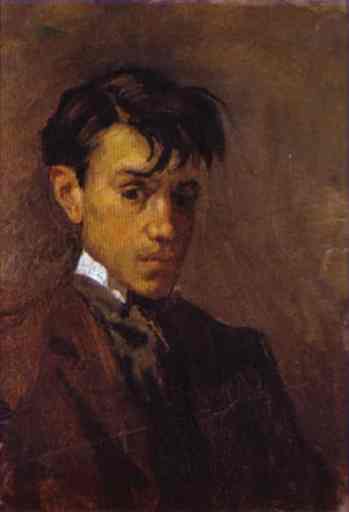
Picasso’s father changed teaching jobs in 1895, and moved to the Escuela de Bellas Artes in Barcelona. Pablo Picasso was enrolled in the school at age fourteen and he passed the exams and entered senior level courses in classical art and still-life. The self portrait above was completed in 1896 when Picasso was fifteen.

Shortly after moving away from academics, Picasso began to exhibit his artwork. His talent was immediately recognized with awards and acclaim. Picasso lived in Madrid from January to April 1901where he received the news of his friend’s (Casagemas) suicide. He produced several works in response during this period of his life in Madrid. His artworks were now signed “Picasso” rather than “P.R. Picasso”.

Picasso’s Blue Period began toward the end of 1901and extended through October 1904; his work from this period feature predominantly blue palettes and a theme of alienation, dismal images of people in poverty, and circus themes.

By the end of 1904 Picasso’s subject-matter began to brighten and the dominant colors that characterized his works from this period feature a pink tint, initiating what is conventionally termed his Rose period.

The next major stage of Picasso’s artwork was marked by his relationship with Braque. Together Picasso and Braque created works of art in the style known as “cubism” in the years from 1910 to 1914. After his marriage to Olga Koklova in 1918 and the birth of his son Paolo in 1921 Picasso’s art began to include women and children as subjects and continued in the cubism style.

After his marriage failed, he entered a new relationship that was reflected in his work. This change was evidenced by new ideas and themes. There were rises and falls of positive feelings and joy depicted in his paintings followed by a move to guilt and anger.

In 1936 the Spanish Civil War resulted in a new trend in his work that demonstrated a rage, especially in his painting Guernica (1937). Violence came shining through in his prevalent themes.

After the civil war, and the series of paintings that went from expressing rage there was an eventual move to more peaceful works. Picasso moved to the south of France where he found a new lover and, as always, regardless of what else might be going on in his life, he continued to paint.

Picasso was a unique artist, with a powerful new style and personality and his work grew and matured through the many stages of his career, none of which were easily explainable and which have provided critics and patrons with an enormous body of work as well as a full and varied life to ponder. He traveled and created art in ways that many artists would never imagine possible while maintaining the level of artistic production that Picasso maintained. His imagination, creativity, and his artwork are unmatched in modern times and the loss of creative force of his personality leaves a gaping void in the artistic community. Picasso was a formidable contributor to the development of serious art in the 20th century and his successor has not yet emerged.

The Three Musicians, 1921
In 1921 Pablo Picasso completed two similar paintings that he called The Three Musicians. The style of these paintings is the synthetic cubist style. There are two paintings are similar in quality and contain the images of a harlequin, a pierrot, and a monk. Pierrot and harlequin are characters from an old Italian comic theatre called commedia dell’arte. Thus the painting is a whimsical interpretation of the comic theatre. The three musicians depicted are generally assumed to be Picasso, Guillaume Apollinaire and Max Jacob. Apollinaire and Jacob were both poets and were very close friends of Picasso in the 1910’s. Apollinaire died in 1918 due to the Spanish flu and Jacob entered a monastery in 1921 when the painting was completed.

The musicians in the painting each have a part. On the left-hand side, the masked pierrot is playing the clarinet. On the right side the singing monk is holding a sheet of music. In the center, the harlequin is playing the guitar. There is also a dog in the background lying on the floor behind the guitarist.

The jigsaw puzzle shapes in the paintings are characteristic of the synthetic cubist style. The different flat planes and colors and shades that look like paper cut outs are typical in cubism. The overlapping figures and shapes located at the center of the piece are more complicated than the ones closer to the edge. The color hues are brighter at the center and darker on the outside surrounding the bright center. The posing figures give the work a feeling of monumentality and mystery. Both paintings thematically demonstrate the cubist characteristics and are two important masterpieces created by Picasso.


Guernica, 1937
In his mural Guernica, Picasso illustrated the horrors of war as waged by military forces attacking targets that have no strategic military value. The Spanish commissioned Picasso to create this mural to visually evoke the horrors inflicted upon the civilians in the Spanish town of Guernica on April 27, 1937 by the German soldiers under the rule of Hitler. Within fifteen days of the incident, Picasso began work on Guernica. Picasso, who was appalled by the incident, did an excellent job evoking the horror on his canvas. The mural served as an effective communication tool, demonstrating to the international community the horrors of the Spanish civil war. The mural was toured around the world.
The images depicted in Picasso’s Guernica are horrifying. The backdrop is a room filled with images of people and animals being slaughtered, homes being burned, and visions of mass confusion. The left portion of the mural shows a woman in agony as she holds her murdered child. A bull stands above the woman looking at the carnage. In the top center of the mural is a simple light shining down on the misery. A horse that has been stabbed staggers just below the light with a look of utter terror on its face. The horse is trampling a man who is holding a broken sword in his right hand. This must be the sword that stabbed the horse. To the right of the horse is a man's face with an arm extending from over his head in what seems to be a flying motion holding a candle light. The look on the man's face depicts shock and disbelief. Below the man's head is a woman who seems to be stumbling through the room in a state of shock and confusion. She is looking up toward the light as if she is looking for hope or sanity but all she finds is horror and carnage. To the right of the woman is a man who seems to be on fire and falling. He is possibly falling from the open window of a building which is just behind him.
We chose Guernica out of Picassos many works of art because it effectively evokes the horrors of an unjustified attack. It shows the state of confusion and carnage experienced after an attack just like we experienced on September 11, 2001 in New York, Virginia, and Pennsylvania. These images are as relevant today as in 1937.

Massacre in Korea, 1951

Picasso lived in Paris during the First World War and many of his paintings from those years portray the destruction of war. In his paintings from that period skulls, abstract images, flayed animals and gore are prevalent. Massacre in Korea depicts events from a time when the United States denied having committed what Picasso believed was the mass murder of innocent civilians. He condemned the United States for their involvement in the Korean War and Massacre in Korea represents one of his most political works.

The setting for the alleged mass murder was at No Gun Ri, July 1950. It was believed that 300 innocent civilian refugees were hiding in a tunnel when they were confronted by U.S. Soldiers. Massacre in Korea is divided into two distinct sections. In the left half of the canvas a group of naked Korean women and children are depicted as gathered at the foot of a mass grave. Their nakedness implies the vulnerability of the Korean subjects. In the right half of the canvas a number of heavily armed soldiers represent the United States military. Their limbs, gigantic and over stated, emphasize strength and control of the situation. The soldiers wear shields and masked helmets to shield their identity and their weapons are futuristic giving the impression that the ammunition they use is mysterious and threatening. Picasso believed that germ warfare was used in this incident.

The United States continued to deny the Massacre. In 1999, United States veterans confirmed that the massacre had occurred. Results of an investigation were released in 2001 by the United States military that there had been no preplanned attack on any civilians and that any unfortunate tragedy was an inherent aspect of war. The United States continues to deny any use of germ warfare.

Massacre in Korea, never one of Picasso’s most famous paintings, remains one of his most politically controversial.

Images:
Pablo Picasso, Self, 1896
http://www.join2day.net/abc/P/picasso/picasso2.JPG
Pablo Picasso, The Three Musicians, 1921
http://lulu.esm.rochester.edu/rdm/graphics/tm.jpg
Pablo Picasso, Guernica, 1937
http://records.viu.ca/~lanes/english/hemngway/picasso/guernica.htm
Pablo Picasso, Massacre in Korea, 1951
http://tribes.tribe.net/coolearth/photos/6b77a520-7037-4b99-820a-2f4ea4af81f5

Material on Picasso’s Biography:

Langton, John. "Picasso, Pablo." The Oxford Companion to Western Art.Ed. Hugh Brigstocke. Oxford Art Online. 14 Feb. 2009<http://libproxy.uta.edu:3439/subscriber/article/opr/t118/e2042>.McQuillan, Melissa. "Picasso, Pablo." Grove Art Online. Oxford ArtOnline. 10 Feb. 2009<http://libproxy.uta.edu:3439/subscriber/article/grove/art/

Material on The Three Musicians:

http://www.fulcrumgallery.com/Pablo-Picasso/Three-Musicians_26589.htm
http://en.wikipedia.org/wiki/Three_Musicians

Material on Guernica:

http://records.viu.ca/~lanes/english/hemngway/picasso/guernica.htm

Material on Massacre in Korea:

http://en.wikipedia.org/wiki/Massacre_in_Korea
http://www.martinshaw.org/warandgenocide/massacre.htm
http://www.artchive.com/artchive/P/picasso.html