 Pablo Picasso, whose full name is, Pablo Diego José Francisco de Paula Juan Nepomuceno María de los Remedios Cipriano de la Santísima Trinidad Clito Ruiz y Picasso is one of the most important figures in 20th century European art. He co-invented a new kind of art (modern art) and constituted a dominant force in the defining of twentieth century culture. Picasso incorporated many events in his life and in the political world into his expression of modern art and in brining that art to life in front of the mass audience he helped to create.
Picasso was born in Malaga, Spain in 1881. His first art lessons were received were from his Father in 1888. His father acknowledged and encouraged his progress and worked to foster the emerging talent and proficiency of the young Picasso in his art.
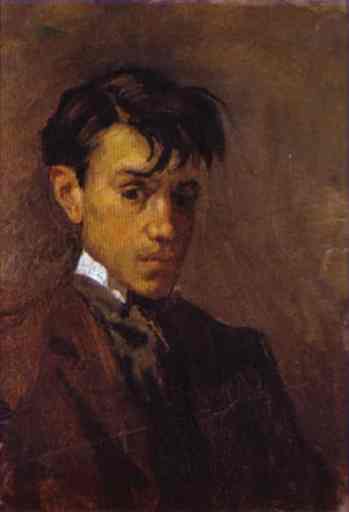
Picasso’s father changed teaching jobs in 1895, and moved to the Escuela de Bellas Artes in Barcelona. Pablo Picasso was enrolled in the school at age fourteen and he passed the exams and entered senior level courses in classical art and still-life. The self portrait above was completed in 1896 when Picasso was fifteen.
Shortly after moving away from academics, Picasso began to exhibit his artwork. His talent was immediately recognized with awards and acclaim. Picasso lived in Madrid from January to April 1901where he received the news of his friend’s (Casagemas) suicide. He produced several works in response during this period of his life in Madrid. His artworks were now signed “Picasso” rather than “P.R. Picasso”.
Picasso’s Blue Period began toward the end of 1901and extended through October 1904; his work from this period feature predominantly blue palettes and a theme of alienation, dismal images of people in poverty, and circus themes.
By the end of 1904 Picasso’s subject-matter began to brighten and the dominant colors that characterized his works from this period feature a pink tint, initiating what is conventionally termed his Rose period.
The next major stage of Picasso’s artwork was marked by his relationship with Braque. Together Picasso and Braque created works of art in the style known as “cubism” in the years from 1910 to 1914. After his marriage to Olga Koklova in 1918 and the birth of his son Paolo in 1921 Picasso’s art began to include women and children as subjects and continued in the cubism style.
After his marriage failed, he entered a new relationship that was reflected in his work. This change was evidenced by new ideas and themes. There were rises and falls of positive feelings and joy depicted in his paintings followed by a move to guilt and anger.
In 1936 the Spanish Civil War resulted in a new trend in his work that demonstrated a rage, especially in his painting Guernica (1937). Violence came shining through in his prevalent themes.
After the civil war, and the series of paintings that went from expressing rage there was an eventual move to more peaceful works. Picasso moved to the south of France where he found a new lover and, as always, regardless of what else might be going on in his life, he continued to paint.
Picasso was a unique artist, with a powerful new style and personality and his work grew and matured through the many stages of his career, none of which were easily explainable and which have provided critics and patrons with an enormous body of work as well as a full and varied life to ponder. He traveled and created art in ways that many artists would never imagine possible while maintaining the level of artistic production that Picasso maintained. His imagination, creativity, and his artwork are unmatched in modern times and the loss of creative force of his personality leaves a gaping void in the artistic community. Picasso was a formidable contributor to the development of serious art in the 20th century and his successor has not yet emerged.
 The Three Musicians, 1921
In 1921 Pablo Picasso completed two similar paintings that he called The Three Musicians. The style of these paintings is the synthetic cubist style. There are two paintings are similar in quality and contain the images of a harlequin, a pierrot, and a monk. Pierrot and harlequin are characters from an old Italian comic theatre called commedia dell’arte. Thus the painting is a whimsical interpretation of the comic theatre. The three musicians depicted are generally assumed to be Picasso, Guillaume Apollinaire and Max Jacob. Apollinaire and Jacob were both poets and were very close friends of Picasso in the 1910’s. Apollinaire died in 1918 due to the Spanish flu and Jacob entered a monastery in 1921 when the painting was completed.
The musicians in the painting each have a part. On the left-hand side, the masked pierrot is playing the clarinet. On the right side the singing monk is holding a sheet of music. In the center, the harlequin is playing the guitar. There is also a dog in the background lying on the floor behind the guitarist.
The jigsaw puzzle shapes in the paintings are characteristic of the synthetic cubist style. The different flat planes and colors and shades that look like paper cut outs are typical in cubism. The overlapping figures and shapes located at the center of the piece are more complicated than the ones closer to the edge. The color hues are brighter at the center and darker on the outside surrounding the bright center. The posing figures give the work a feeling of monumentality and mystery. Both paintings thematically demonstrate the cubist characteristics and are two important masterpieces created by Picasso.
 Guernica, 1937
In his mural Guernica, Picasso illustrated the horrors of war as waged by military forces attacking targets that have no strategic military value. The Spanish commissioned Picasso to create this mural to visually evoke the horrors inflicted upon the civilians in the Spanish town of Guernica on April 27, 1937 by the German soldiers under the rule of Hitler. Within fifteen days of the incident, Picasso began work on Guernica. Picasso, who was appalled by the incident, did an excellent job evoking the horror on his canvas. The mural served as an effective communication tool, demonstrating to the international community the horrors of the Spanish civil war. The mural was toured around the world.
The images depicted in Picasso’s Guernica are horrifying. The backdrop is a room filled with images of people and animals being slaughtered, homes being burned, and visions of mass confusion. The left portion of the mural shows a woman in agony as she holds her murdered child. A bull stands above the woman looking at the carnage. In the top center of the mural is a simple light shining down on the misery. A horse that has been stabbed staggers just below the light with a look of utter terror on its face. The horse is trampling a man who is holding a broken sword in his right hand. This must be the sword that stabbed the horse. To the right of the horse is a man's face with an arm extending from over his head in what seems to be a flying motion holding a candle light. The look on the man's face depicts shock and disbelief. Below the man's head is a woman who seems to be stumbling through the room in a state of shock and confusion. She is looking up toward the light as if she is looking for hope or sanity but all she finds is horror and carnage. To the right of the woman is a man who seems to be on fire and falling. He is possibly falling from the open window of a building which is just behind him.
We chose Guernica out of Picassos many works of art because it effectively evokes the horrors of an unjustified attack. It shows the state of confusion and carnage experienced after an attack just like we experienced on September 11, 2001 in New York, Virginia, and Pennsylvania. These images are as relevant today as in 1937.
 Massacre in Korea, 1951
Picasso lived in Paris during the First World War and many of his paintings from those years portray the destruction of war. In his paintings from that period skulls, abstract images, flayed animals and gore are prevalent. Massacre in Korea depicts events from a time when the United States denied having committed what Picasso believed was the mass murder of innocent civilians. He condemned the United States for their involvement in the Korean War and Massacre in Korea represents one of his most political works.
The setting for the alleged mass murder was at No Gun Ri, July 1950. It was believed that 300 innocent civilian refugees were hiding in a tunnel when they were confronted by U.S. Soldiers. Massacre in Korea is divided into two distinct sections. In the left half of the canvas a group of naked Korean women and children are depicted as gathered at the foot of a mass grave. Their nakedness implies the vulnerability of the Korean subjects. In the right half of the canvas a number of heavily armed soldiers represent the United States military. Their limbs, gigantic and over stated, emphasize strength and control of the situation. The soldiers wear shields and masked helmets to shield their identity and their weapons are futuristic giving the impression that the ammunition they use is mysterious and threatening. Picasso believed that germ warfare was used in this incident.
The United States continued to deny the Massacre. In 1999, United States veterans confirmed that the massacre had occurred. Results of an investigation were released in 2001 by the United States military that there had been no preplanned attack on any civilians and that any unfortunate tragedy was an inherent aspect of war. The United States continues to deny any use of germ warfare.
Massacre in Korea, never one of Picasso’s most famous paintings, remains one of his most politically controversial.
Images:
Pablo Picasso, Self, 1896
http://www.join2day.net/abc/P/picasso/picasso2.JPG
Pablo Picasso, The Three Musicians, 1921
http://lulu.esm.rochester.edu/rdm/graphics/tm.jpg
Pablo Picasso, Guernica, 1937
http://records.viu.ca/~lanes/english/hemngway/picasso/guernica.htm
Pablo Picasso, Massacre in Korea, 1951
http://tribes.tribe.net/coolearth/photos/6b77a520-7037-4b99-820a-2f4ea4af81f5
Material on Picasso’s Biography:
Langton, John. "Picasso, Pablo." The Oxford Companion to Western Art.Ed. Hugh Brigstocke. Oxford Art Online. 14 Feb. 2009<http://libproxy.uta.edu:3439/subscriber/article/opr/t118/e2042>.McQuillan, Melissa. "Picasso, Pablo." Grove Art Online. Oxford ArtOnline. 10 Feb. 2009<http://libproxy.uta.edu:3439/subscriber/article/grove/art/
Material on The Three Musicians:
http://www.fulcrumgallery.com/Pablo-Picasso/Three-Musicians_26589.htm
http://en.wikipedia.org/wiki/Three_Musicians
Material on Guernica:
http://records.viu.ca/~lanes/english/hemngway/picasso/guernica.htm
Material on Massacre in Korea:
http://en.wikipedia.org/wiki/Massacre_in_Korea
http://www.martinshaw.org/warandgenocide/massacre.htm
http://www.artchive.com/artchive/P/picasso.html



No comments:
Post a Comment